Cleaning guide
How to Get Dog or Cat Urine Smell Out of Carpet
By Judaah Chandler7 min read
In this article
Why does pet urine smell keep coming back after cleaning?
Pet urine odor returns after cleaning because the smell does not stay on the surface where most cleaning happens. When a dog or cat has an accident, the urine soaks down through the carpet fiber into the backing and the pad underneath, and in repeated or heavy cases it reaches the subfloor. A surface pass freshens the fiber you can see and touch, but it does not reach the urine that settled into the pad below. So the room smells better for a few days, then the odor comes back because the deeper residue is still there. That is exactly why pet urine odor comes back after cleaning when only the surface is treated. Reaching the source is the whole point of treating pet urine properly.
Why do vinegar and baking soda fall short on pet urine odor?
Vinegar and baking soda are the most common home remedies for pet urine, and they fall short for a specific reason. They mostly work at the surface, while the odor source sits deeper in the pad and backing. Baking soda sprinkled on carpet absorbs some surface moisture and odor, but it cannot reach the residue that soaked below the fiber. Vinegar can cut some smell for a short time, yet it does not break down the dried urine that causes the lingering odor. Dried urine leaves behind salts and uric acid crystals that reactivate whenever moisture reaches them. A home remedy that covers the smell for a week is not the same as a treatment that reaches and breaks down the source. That gap is why deep or repeated pet urine usually needs more than a do-it-yourself pass.
How does Aggie actually remove dog and cat urine odor?
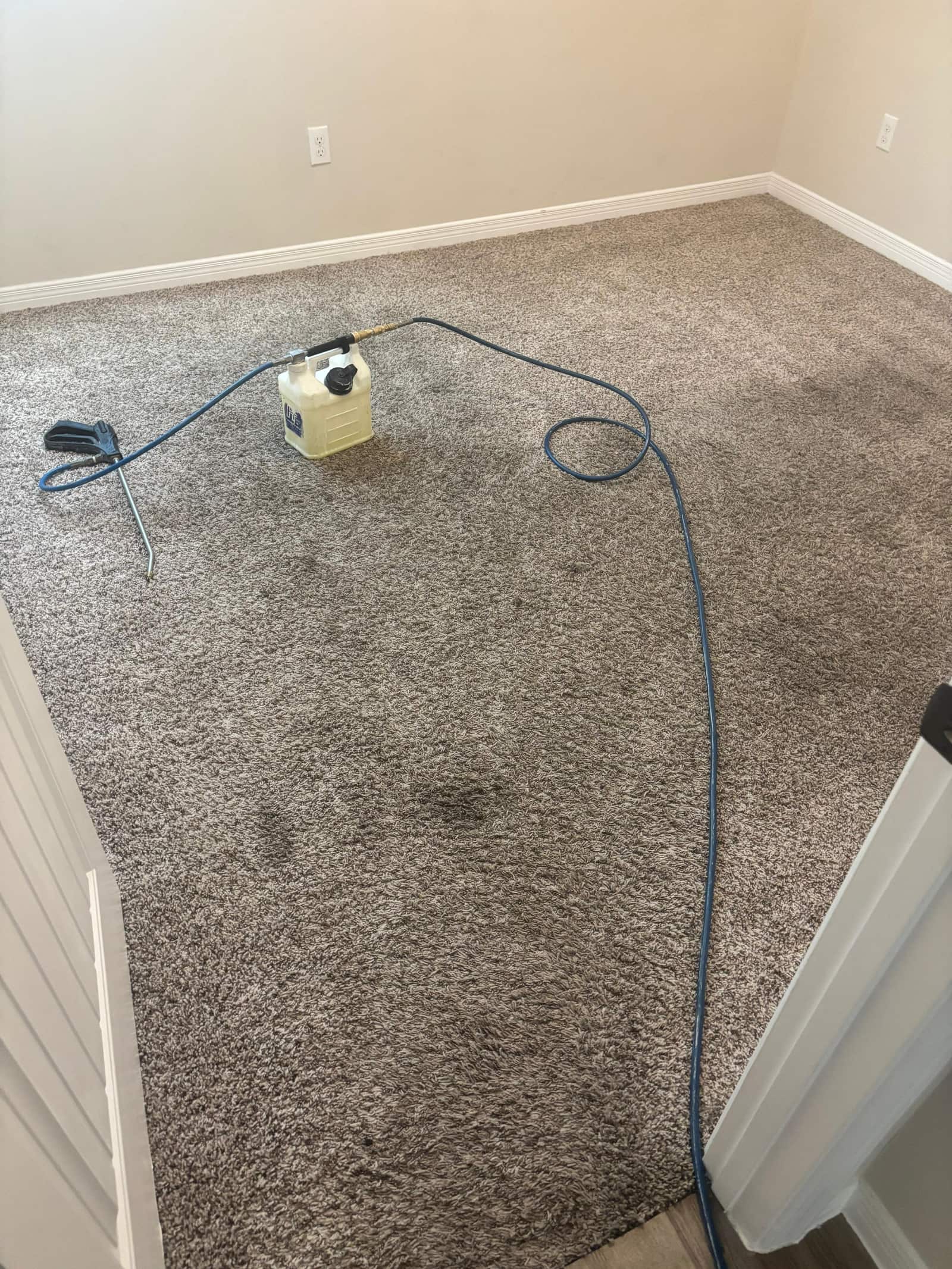
Aggie treats pet urine at the source rather than masking it at the surface. The process starts by flooding the affected area with a peroxide-based solution, applied in enough volume to reach the pad where the urine soaked in. That solution is designed to break down the urine and the odor at the source, not just on the fiber face. Once it has worked through the pad, Aggie extracts it with a Water Claw, a strong-suction sub-surface tool that pulls the solution and the broken-down urine out of the pad. Reaching the pad with the right solution and then pulling it back out is what addresses the odor where it lives. Results still depend on how deep the urine went, how old it is, and what was used on it before. For pet urine removal in Las Cruces, that source-level approach is what separates it from a surface pass.
What is a Water Claw and why does it matter for pet urine?
A Water Claw is a sub-surface extraction tool built specifically for pulling liquid out of the carpet pad. A normal cleaning wand works across the surface of the carpet. A Water Claw is pressed down over the affected spot, and its strong suction reaches through the carpet and backing to draw fluid out of the pad below. When the area is flooded with a peroxide-based solution to break down the urine, the Water Claw is what removes that solution along with the dissolved urine from deep in the pad, rather than leaving it to soak further in. This matters because pet urine odor lives in the pad, so a tool that can flush and recover liquid at that depth does something a surface wand cannot. It is the recovery half of a source-level treatment, and without it, flooding the area would only push the problem deeper.
How is old, set-in urine different from a fresh accident?
Fresh and old pet accidents behave differently, and that affects what cleaning can do. A fresh accident has not had time to soak fully into the pad, so prompt treatment can reach more of it before it sets and spreads. An older accident is a harder case. Urine that has dried, been walked on, and been rewet many times builds up layers of residue that work progressively deeper into the pad and subfloor. Repeated accidents in the same spot make it worse, because each one adds to what is already there. The longer a spot has been active, the more the odor source extends beyond what any single treatment reaches. This is why old urine sometimes needs more than one visit, and why it is handled as part of a deeper carpet cleaning rather than a quick spot pass.
Does the Las Cruces climate or prior products change the result?
Both the local climate and what was used before affect how pet urine responds to treatment. Las Cruces stays dry for much of the year, and in dry air the dried urine crystals in a pad can sit quietly with little smell. When humidity rises, often from an evaporative cooler running in summer, those crystals reactivate and the odor returns in a spot that seemed fine through the drier months. Prior products matter too. Store-bought enzyme cleaners, deodorizers, and masking sprays applied before a professional visit can change how the area responds, and some leave residue that has to be accounted for. Telling Aggie what was already tried on a spot helps set the right approach. None of this guarantees a perfect result, because depth, age, and prior treatment all shape what is achievable, but a source-level method gives the area its strongest chance.
Related services
Related cleaning services
Getting pet urine odor out of carpet depends on reaching the pad where it soaked in, not just cleaning the surface. Aggie Carpet and Tile Cleaning provides pet urine removal and carpet cleaning in Las Cruces for homes, rentals, and businesses.
Questions
Common questions about this topic
Will baking soda and vinegar get cat urine smell out of carpet for good?
They rarely solve it for good. Baking soda and vinegar work mostly at the surface, while cat urine soaks into the carpet pad and backing where the odor actually sits. They can reduce the smell for a short time, but they do not break down the dried urine crystals deep in the pad, so the odor tends to return, especially when humidity rises. For a spot that keeps coming back, a source-level treatment that reaches the pad is usually what is needed.
Why does my carpet smell like dog urine only when it is humid?
Dried urine leaves salts and uric acid crystals in the carpet pad and backing. In dry air these produce little smell, but when moisture reaches them, from humid weather or an evaporative cooler, they reactivate and release odor again. The humidity does not create new urine. It wakes up residue that a surface cleaning never removed. In Las Cruces, swamp cooler use in summer is a common reason pet odor returns in a spot that seemed fine all winter.
Can old, set-in pet urine odor be removed?
Often it can be improved significantly, but old urine is harder than a fresh accident and results are not guaranteed. Urine that has dried and been rewet many times works deep into the pad and subfloor, so it may take more solution, stronger extraction, and sometimes more than one visit. In severe cases where the pad is saturated, replacing the pad is what finally resolves the odor. Aggie reviews the spot and gives an honest picture of what is realistic before starting.
Do I need to replace the carpet pad to remove pet urine smell?
Not always. Many pet urine problems are addressed by flooding the area with a treatment solution that reaches the pad and then extracting it with strong sub-surface suction, which removes the urine without replacing anything. Pad replacement comes into the picture only in severe cases, where urine has saturated the pad repeatedly over a long period and the odor source is too deep to flush out. Aggie can assess whether extraction is enough or whether the pad needs to come up.
Is professional pet urine treatment guaranteed to remove all odor?
No honest cleaner can guarantee complete odor removal, because the result depends on how deep the urine went, how old it is, how many accidents happened in the same spot, and what products were used before. A source-level treatment that reaches and extracts the pad gives the area its strongest chance, and many spots resolve well. Severe, long-standing contamination can need repeat treatment or pad replacement. Aggie sets honest expectations after reviewing the area rather than promising a guaranteed outcome.
Keep reading
Related articles
More cleaning guides connected to this topic.
Why Pet Urine Odor Comes Back After Cleaning
A clear explanation of how pet urine can move below the visible surface.
Read the guideHow Much Does Carpet Cleaning Cost in Las Cruces?
A straight look at what carpet cleaning costs in Las Cruces and what changes the price.
Read the guideHow Long Does Carpet Take to Dry After Cleaning?
What affects carpet drying time after cleaning and how to help rooms dry.
Read the guide